Bills you can't just cancel: notice periods on Australian recurring payments (2026)
Notice periods on Australian recurring payments, and the date that actually decides whether you can leave.
Most advice about recurring costs assumes you can stop paying whenever you like. Cancel the subscription, cancel the direct debit, done.
It does not work like that for a large part of what leaves an Australian household account. Gyms, club memberships, roadside assistance, insurers, phone plans and strata agreements all run on notice periods, and the date that matters is not the due date. It is the date the notice window closes, which lands weeks earlier than most people expect.
Miss it and you pay for another cycle. Sometimes another year.
The date nobody tracks
Every recurring payment has three dates, and most people only write down one:
The due date. When the money leaves.
The renewal date. When the term rolls over.
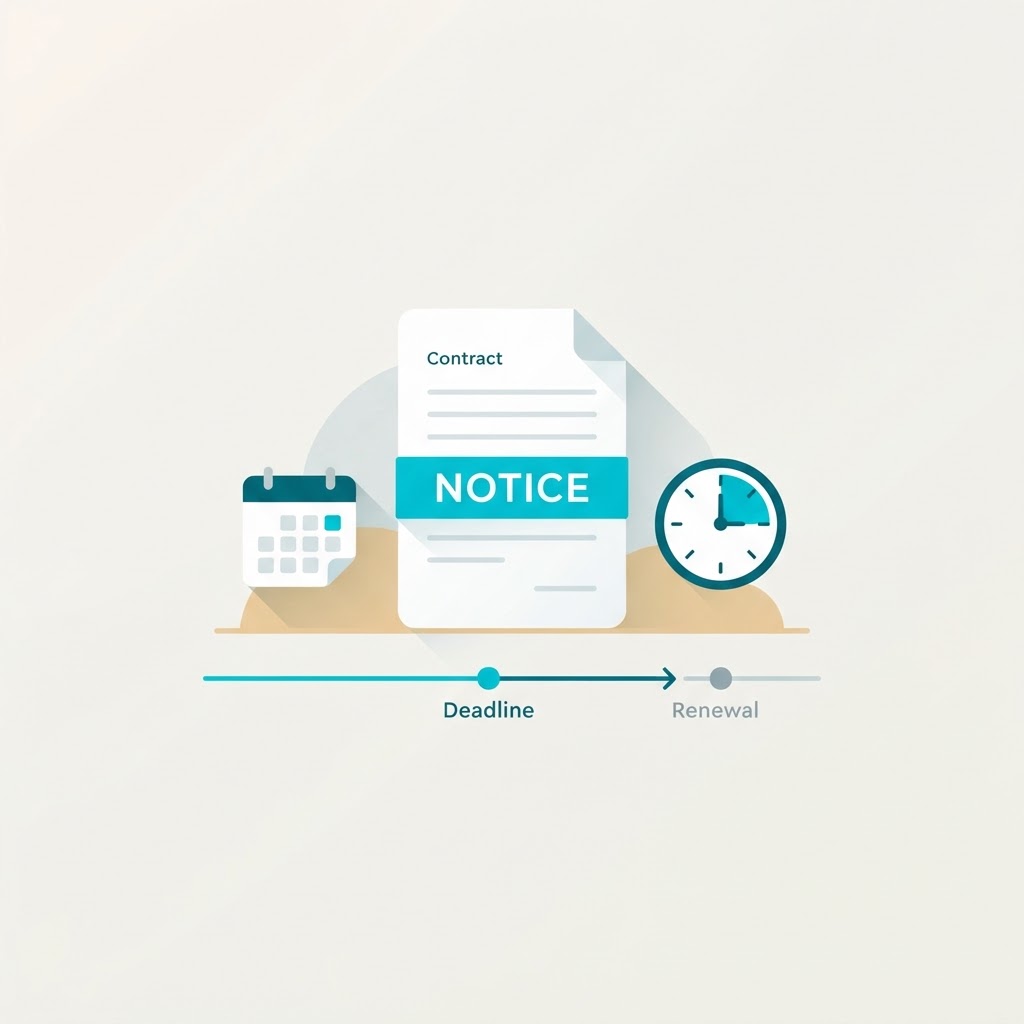
The notice date. The renewal date minus the notice period. This is the deadline that decides whether you can leave, and it is the only one that requires action.
A gym on 30 days notice that renews on 1 March has a notice date of 30 January. A reminder on 1 March is a reminder that arrives after the deadline. The payment is not the event. The notice window is.
The notice-period map
Notice periods in Australia are set by the contract, by industry codes, or by both. These are the ranges you will actually encounter.
| Payment | Typical notice | What happens if you miss it |
|---|---|---|
| Gym or fitness studio | 14 to 30 days, in writing | Another fortnight or month, sometimes a full new term |
| Club or association membership | 30 days to end of financial year | Renewed for another year |
| Roadside assistance | Usually before renewal date, varies by club | Auto-renewed for 12 months |
| Home, car or contents insurance | Cancel anytime, but check the refund basis | You pay the full next period |
| Phone or device plan | Device term runs to completion | Remaining handset repayments become payable |
| Strata management agreement | 3 months in most states | Another 12 months of management fees |
| Childcare or school | 2 to 4 weeks | Another billing cycle, or a lost place |
| Software subscription | 0 to 30 days | Another month or year, charged instantly |
None of these are universal. The contract you signed sets the number, and where a state code of practice applies, it can override a harsher clause.
Why the rules are built this way
Auto-renewal is not an accident. It is the business model. A membership that renews unless you remember to act is worth considerably more than one that lapses unless you remember to pay, and the notice period is the mechanism that makes the difference work.
That asymmetry is exactly what Australian Consumer Law now targets. Since 9 November 2023, it has been unlawful to propose, use or rely on an unfair term in a standard-form consumer contract, and the penalties are serious: up to A$50 million, three times the benefit obtained, or 30% of adjusted turnover, whichever is greatest. Individuals face up to A$2.5 million.
The ACCC has already tested automatic renewal in court. In its first unfair contract terms case, against waste company JJ Richards & Sons, one of the clauses struck out bound customers to a further term unless they cancelled within a 30-day window before the term ended. The court found it unfair. A clause that makes you responsible for remembering a narrow deadline, with no reminder from the business, is the pattern the regulator has been watching.
Two practical consequences:
A notice period is not automatically unfair. Fourteen to thirty days is normal and enforceable. What gets scrutinised is a notice period so one-sided that it traps you, or a term that renews you for a long period when you had no realistic way to know the deadline.
Reminders are the difference between a clause and a trap. Some industries now require them. Western Australia's Fitness Industry Code of Practice, for example, allows cancellation by simple email and caps how long a membership can run after you give notice. Where a code applies, it beats whatever the contract says.
How to find your actual notice period in ten minutes
You do not need to read a full terms document. You need one paragraph, and it is almost always findable in under ten minutes.
1. Search your email for the welcome message. Search terms that work: "membership agreement", "welcome", "terms and conditions", "your policy", "confirmation of cover". The date you joined is on it, and so is the notice clause.
2. Search for the renewal notice. "Renewal", "is due", "expiring", "your membership is about to". Insurers and clubs send these before the term ends, and they usually restate the clause.
3. Search the provider's current terms page. If the app is a chain, the cancellation clause is published. As an example of what a standard clause looks like, Anytime Fitness Australia's published terms require written notice at least 30 days before the initial term expiry date.
4. Note the mechanism, not just the number. Look for the words in writing, via your home club, by post, no later than, and any processing period after notice. A 30-day notice period with a 14-day processing tail is really a 44-day exit.
5. Write down the notice date, not the notice period. The number will not help you in February. The date will.
The four traps that cost people money
Notice counts from renewal, not from when you stopped using it. Gym attendance is irrelevant. The clock starts from the contract date.
Written only. A phone call to the front desk, a verbal cancellation at reception, or a message to an instructor is not notice under most agreements. If the clause says in writing, send it in writing and keep the sent copy.
Processing periods after notice. Several chains terminate the agreement a set number of days after your notice ends, which pushes the final payment past what you planned for. Ask, in writing, "on what date does my membership end and what is the final amount owing".
Annual billed monthly, or fortnightly billed like monthly. Paying $32 a fortnight feels like $64 a month; it is closer to $69. Over a 12-month contract that difference is invisible in the app and real in the bank.
If you have already missed the window
The deadline passing does not always mean you have no options.
Ask for a discretionary release. In writing, state that you intended to cancel, that you no longer use the service, and ask for the renewal to be reversed. A meaningful share of these are granted, particularly by staffed local businesses.
Check whether the term itself was enforceable. A minimum term longer than 12 months, or a cancellation regime that is disproportionate, can be challenged. A Western Australian court has previously found minimum terms over 12 months, and disproportionate cancellation demands, to be unfair.
Raise it with the right body. State and territory consumer affairs offices handle gyms and general memberships. The Telecommunications Industry Ombudsman handles phone and internet disputes. AFCA handles insurance disputes. Complaining is free, and businesses respond differently once a complaint is on file.
For insurance, cancel rather than wait. Policies can generally be cancelled mid-term, with a refund reflecting the unused portion. Waiting for the renewal notice means paying for a period you did not want.
How to stop this from happening again
The fix is not discipline. It is putting the right date in the right place, once.
Record the notice date as its own date. Not the renewal date, not the due date. If the app you use lets you store a notice period, let it calculate backwards and remind you while the window is open.
Get it into the calendar you already look at. A reminder you have to go looking for is a reminder you will miss. Digital Crate exports renewals and action dates to a calendar feed for this reason, and it is free.
Put it somewhere more than one person can see. The reason notice periods get missed is usually that one person is holding all of them in their head, and there is no second copy.
Review once a quarter. New memberships arrive quietly, usually at a sign-up desk, not in an app.
Try the free tracker Add your first membership with its notice period and see the action date it produces. If you want the wider picture, our guide to the best app to track recurring payments in Australia compares the options, and the subscription cost calculator will tell you what it all adds up to.
The short version
Some recurring payments end when you stop paying. The expensive ones end when you give notice, weeks before the money is due, in a form the business accepts, to a deadline nobody sends you.
Find the notice date for your gym, your club, your roadside assist and any contract you would not re-sign today. Put those dates where you will see them. That single habit is worth more than any cancellation guide, because it means you never have to use one.
Frequently asked questions
Quick answers about Australian subscription spending.
Related guides
Best app to track recurring payments in Australia (2026)
Money guides
How to Get Out of a Gym Contract in Australia (2026): The Five Legal Exits
Money guides
How to Cancel Your Gym Membership in Australia (2026)
Cancellation guides
Membership Tracker App for Gym, Club & Association Memberships (AU, 2026)
Money guides
How to Get Out of a Phone Contract in Australia (2026)
Money guides
How to Cancel Netflix in Australia (2026)
Cancellation guides