Rocket Money alternatives 2026: 6 apps that track subscriptions for less
Looking beyond Rocket Money in 2026? Here are 6 alternatives compared on price, bank login and subscription tracking — including one that never asks for your bank account.
Quick answer
The best Rocket Money alternatives in 2026 are Monarch Money ($99.99/year, full budgeting suite), Quicken Simplifi ($3.99/month, the cheapest bank-synced tracker) and Digital Crate (free to 5 subscriptions, ~US$2.70/month after, and the only one that never asks for your bank login). Which one fits depends on what made you look for an alternative in the first place.
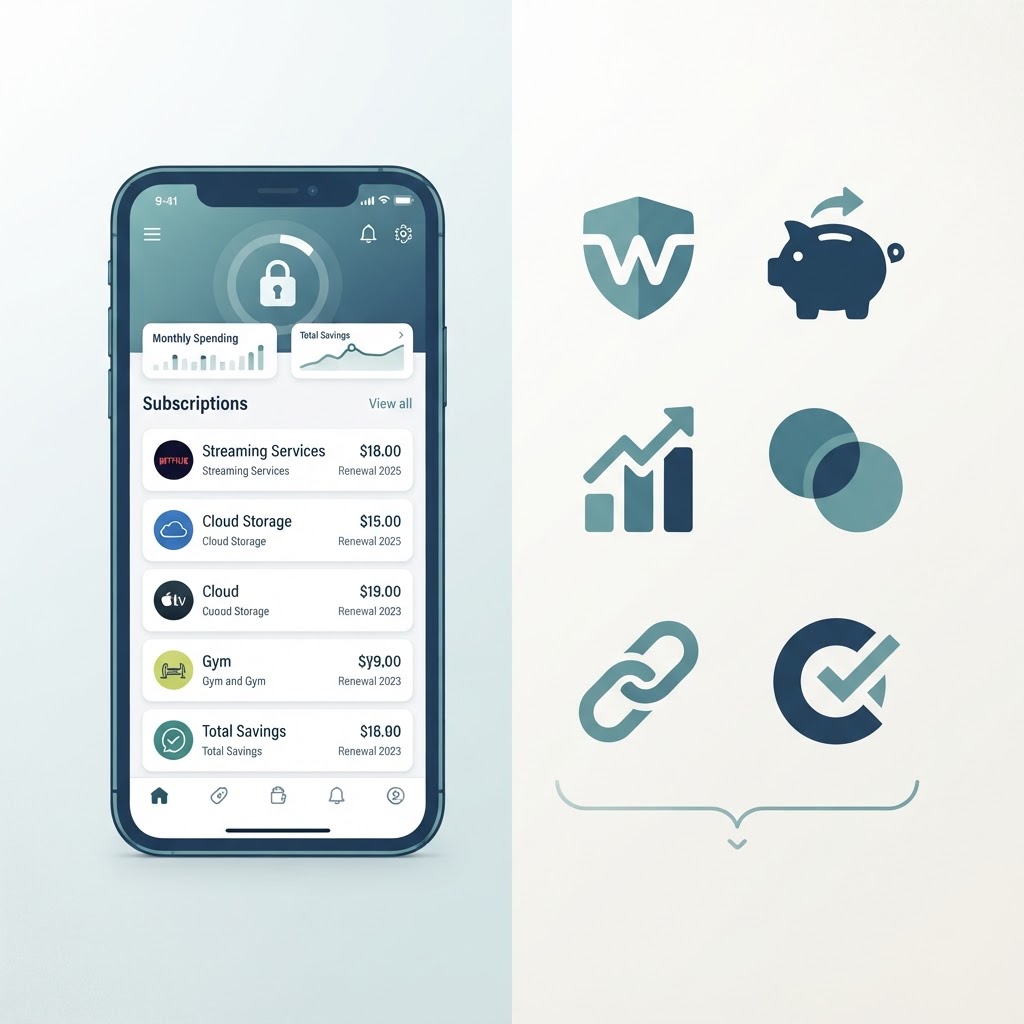
(Full disclosure: we build Digital Crate, one of the alternatives on this list. We've tried to be fair to the rest — Monarch and Simplifi are genuinely good at things we don't do.)
Why people look beyond Rocket Money
Rocket Money (formerly Truebill) is the most famous name in subscription tracking, and for good reason: automatic detection of recurring charges and one-tap cancellation requests are real conveniences. But the common reasons people start searching for alternatives are consistent:
- The pricing is fuzzy. Premium uses a choose-your-own-price model, generally $6–$12/month — but members frequently report being billed annually, so a "$10 choice" arrives as a ~$120 charge. One Reddit thread on a $100-plus annual renewal is titled bluntly: "I thought this was MY app."
- The best features are paywalled. Subscription cancellation and bill negotiation sit behind Premium, and bill negotiation also takes a cut of what it saves you.
- It needs your bank login. Every core feature runs on Plaid, the data aggregator that paid $58 million in 2021 to settle a class action over claims it collected more financial data than users realised.
- It's a budgeting app wearing a subscription hat. If you just want a clean list of what you pay and a reminder before each renewal, you're paying for a lot of features you'll never open.
None of this makes Rocket Money a bad product. It makes it a big product — and there are cheaper, lighter or more private ways to get the actual job done.
The 6 best Rocket Money alternatives in 2026
1. Digital Crate — best if you don't want to connect your bank
The whole app is built around the manual workflow: add your subscriptions once (name, cost, renewal date), and it handles the rest — monthly totals, renewal reminders before money moves, and household sharing so everyone can see who's paying for what. No bank connection, ever; your credentials stay with your bank.
Pricing is the flattest in this list: free for up to 5 subscriptions, then Premium at ~US$2.70/month (billed in your own currency) for unlimited subscriptions, spending insights and household sharing. There's also a one-off Snapshot Report that turns your list into a shareable audit.
The trade-off is the one you'd expect: no automatic transaction scanning. You do a one-time 10-minute audit of your statements, enter what you find, and the reminders take it from there. See our full no-bank-login comparison for the wider landscape.
Best for: people who want the tracking and reminders without the bank login or the $100+ annual bill.
2. Quicken Simplifi — best cheap bank-synced alternative
If your issue with Rocket Money is the price rather than the model, Simplifi is the answer: $3.99/month billed annually ($47.88 for your first year, renewing at $5.99/month). You get automatic transaction import, spending watchlists and a recurring-transactions view that catches subscriptions the same way Rocket Money does — from a company (Quicken) that's been doing personal finance software since the 1980s.
Still requires linking your accounts through an aggregator, and cancellation help isn't included the way Rocket Money Premium does it.
Best for: people who like auto-detection but not Rocket Money's price ladder.
3. Monarch Money — best full-budgeting replacement
Monarch is what people who outgrow subscription tracking graduate to: budgets, net worth, investments, shared household views and excellent transaction categorisation, for $99.99/year or $14.99/month. It's widely regarded as the spiritual successor to Mint. The subscription tools are solid, though recurring-charge management is one feature among dozens rather than the whole point.
It costs more than Rocket Money Premium, needs account linking, and there's no free tier (just a 7-day trial).
Best for: households that want one app for their entire financial life, not just subscriptions.
4. YNAB — best if overspending is the actual problem
YNAB ($109/year or $14.99/month) is zero-based budgeting: every dollar gets a job before the month starts, and subscriptions get planned for rather than discovered. It supports manual entry, so it's usable without bank sync — though most people connect accounts for convenience. There are no renewal reminders and no cancellation service; if your problem is that subscriptions quietly eat your budget, YNAB attacks it from the discipline side instead.
Best for: people whose real goal is stopping the overspending, not just watching it.
5. Bobby — best dead-simple manual tracker (iOS)
Bobby by Yummygum is the minimalist's tracker: add subscriptions, see your monthly total, get renewal notifications. No account needed, no bank login, nothing to configure. It's iOS-only, has no household sharing or web version, and its free version is limited — but as a "just show me the number" app, nothing here is simpler.
Best for: iPhone owners who want the shortest possible path from download to done.
6. A spreadsheet — best free alternative
The answer that was true before apps existed: one row per subscription, a renewal date, a formula for your monthly equivalent total. Free, private by construction, and infinitely customisable — but every reminder, update and renewal check is on you.
Best for: anyone who will genuinely maintain a spreadsheet. They know who they are.
Comparison at a glance
| App | Price | Bank login? | Auto-detection | Renewal reminders | Cancellation help |
|---|---|---|---|---|---|
| Digital Crate | Free to 5 subs; ~US$2.70/mo | Never | No (manual, once) | Yes | Do-it-yourself guides |
| Quicken Simplifi | $3.99/mo (yr 1), then $5.99/mo | Required | Yes | Basic | No |
| Monarch Money | $99.99/yr | Required | Yes | Basic | No |
| YNAB | $109/yr | Optional | If linked | No | No |
| Bobby | Free tier + upgrade | Never | No | Yes | No |
| Rocket Money (for reference) | $6–12/mo Premium | Required | Yes | Yes | Yes (Premium) |
The pattern to notice: the two apps that never ask for your bank login are also the two cheapest on the list. Bank-connected products can spend heavily on marketing because connected accounts are the business model; manual trackers have to win on being useful and cheap. Which brings up the honest question:
Do you actually need auto-detection?
It's the one feature Rocket Money genuinely does better than everyone, so it's worth being blunt about what it costs you.
Auto-detection finds charges that already exist. That's genuinely useful exactly once — the first time you run it, when it surprises you with the three subscriptions you forgot. After that it's a comfort feature, re-reading your transactions every day to confirm what a list you already have already says.
And the surprise it delivers isn't small. Our US subscription spending data shows the average American believes they spend about $86 a month on subscriptions while actually spending closer to $219. You can find that $130 gap with an aggregator — or you can find it in one honest 10-minute look at your own card statements, which is exactly the setup step a manual tracker asks for anyway.
The features that save money after that — a reminder before the $99 annual renewal, a clear list to review when money's tight, a shared view that ends the "who's paying for Disney+?" argument — don't need a bank connection at all.
Which one should you pick?
- Rocket Money's price is the problem → Quicken Simplifi. Same model, roughly a third of the cost.
- You want one app for everything → Monarch Money. It's excellent, just priced accordingly.
- You don't want your bank login in someone else's database → Digital Crate. That's the whole reason it exists, and the free tier means trying it costs nothing but 10 minutes.
- You'd cancel streaming services more if cancelling were easier → whatever tracker you pick, pair it with our step-by-step cancellation guides, linked from every subscription page on the site.
The takeaway
"Rocket Money alternative" doesn't have to mean a slightly different app that still needs your bank login and still bills you annually without warning. The honest split in 2026 is this: if you value automatic detection above all, Simplifi does it cheapest and Monarch does it best. If you value control — over your data, your money and your monthly total — a manual tracker gives you every feature that actually saves cash, at a fraction of the price, with your banking credentials exactly where you left them.
Digital Crate is the manual option: every subscription in one crate, renewal reminders before money moves, household sharing, and a free tier for up to 5 subscriptions. No bank login, no card required. Start free — no card needed.
Frequently asked questions
Quick answers about Australian subscription spending.